



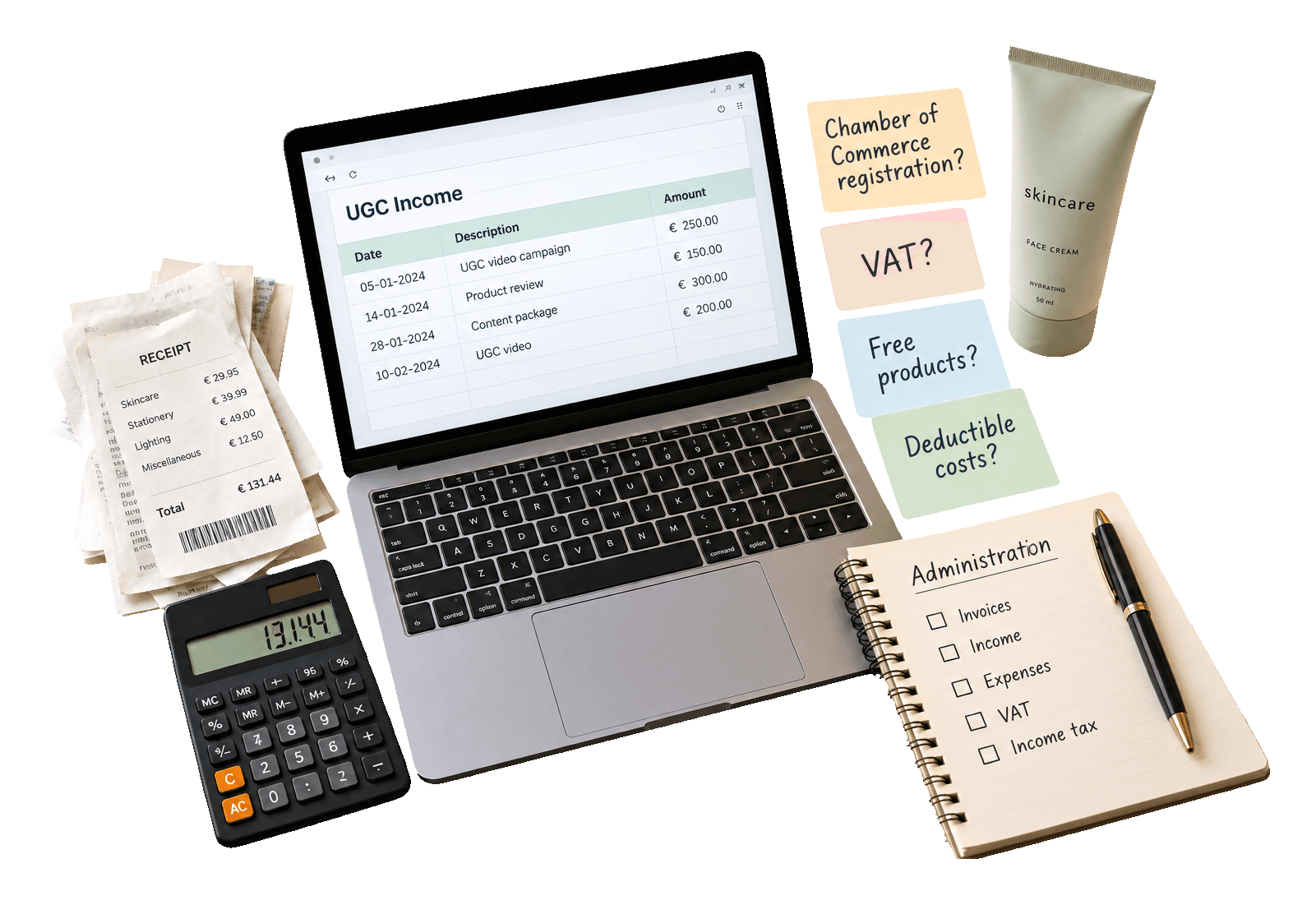
UGC creator taxes are a topic many creators only consider once the first assignments come in. Do you need a Chamber of Commerce registration? Do you have to charge VAT? And do the products you get to keep count as well? Good news: with a few basic rules, you can keep it straightforward.
This article explains your income, the Chamber of Commerce, VAT, and the small business scheme, as well as which costs you can deduct. We focus on the rules in the Netherlands. If you live in another country, different rules apply. Unsure about your situation? Check with the Tax Office or an accountant.
TL;DR
- Income from UGC is taxable in the Netherlands, whether you work as an individual or as an entrepreneur registered with the Chamber of Commerce.
- You can start on UGC.NL without a Chamber of Commerce registration, but the government decides when your activities are no longer a hobby and registration becomes mandatory.
- If you're an entrepreneur, you can opt for the small business scheme with a turnover of up to €20,000 per year, meaning you don't have to charge VAT.
- UGC.NL automatically creates your invoices and considers your VAT situation, but filing and administration remain your responsibility.
Do You Have to Pay Taxes on Your UGC Income?
Yes. Money you earn from UGC is income, and you pay taxes on income. This applies even if you do it alongside your job or studies. The difference lies in how you report it in your income tax return.
If you occasionally take on an assignment, you usually report it as income from other activities. If you work independently, for multiple clients, and with the aim of making a profit, the Tax Office will quickly consider you an entrepreneur. You then report it as business income.
Whether you are an entrepreneur is assessed by the Tax Office based on factors such as your independence, the number of clients, the time you invest, and whether you present yourself as an entrepreneur. There is no fixed amount above which you automatically become an entrepreneur.
Example
Sanne works full-time and makes a few videos a year for a brand. This is usually income from other activities. Tom makes videos every week for different brands, has his own website, and invests in equipment. He is likely an entrepreneur. Most creators start like Sanne and then grow.
Do You Need a Chamber of Commerce Registration as a UGC Creator?
On UGC.NL, you can start without a Chamber of Commerce registration, as an individual. You don't need to establish a business first to take on your first assignment. This makes it easy to discover if UGC suits you.
However, the government decides when something is no longer a hobby. If you consistently earn more, a Chamber of Commerce registration may be required. The Chamber of Commerce looks at whether you work independently, charge for your work, and aim to make a profit. Their website offers a handy check.
UGC.NL informs you about this, but you are responsible for complying with the rules. If you have a business, go to Settings, Finance, and click on Switch to Business under Switch. Complete your open orders first.
VAT and the Small Business Scheme
As an entrepreneur, you are generally required to charge VAT. This means you add VAT to your invoices and remit it to the Tax Office. You receive a VAT identification number when you register with the Chamber of Commerce.
If your turnover does not exceed €20,000 per year, you can opt for the small business scheme, the KOR. You then do not charge VAT and do not file VAT returns. However, you also cannot reclaim VAT on purchases, such as a new ring light. You apply for the KOR yourself with the Tax Office.
During your first verification on UGC.NL, you indicate whether you have a business. Based on this, we account for your VAT situation on your invoices, such as the KOR. You don't have to figure out which VAT amount should be on each invoice. If your situation changes, for example, if you apply for or stop the KOR, update your financial information immediately.
Do Free Products Count as Income?
A surprise for many creators: products you receive for an assignment and get to keep can count as income for the Tax Office. They are a form of payment for your work, even if you don't receive money for them.
Therefore, keep track of which products you have received and their approximate value. This way, you have everything ready when you file your tax return. How you process it depends on your situation. If in doubt, check with the Tax Office or an accountant.
On UGC.NL, the brand indicates in the order whether you can keep the product or if it must be returned. This way, you know in advance what to expect.
Which Costs Can You Deduct?
If you are an entrepreneur, you can deduct business expenses from your profit. You then only pay taxes on what you actually keep. Think of items and services you need to create your content.
A ring light, tripod, or microphone
A portion of your phone and internet costs
Paid apps for editing and subtitles
Props and backgrounds for your recordings
A course or training to improve your skills
If you use something both privately and for business, like your phone, only deduct the business portion. Keep your receipts and invoices well: as an entrepreneur, you must keep your records for seven years.
If you buy something expensive, like a new phone or laptop, you sometimes don't deduct the costs all at once but spread them over a few years. This is called depreciation. Whether and how this applies to your purchase is best checked with an accountant.
How to Keep Your Administration as a UGC Creator
Good administration doesn't have to be complicated. Start with a simple overview, like a spreadsheet. For each assignment, list the date, the brand, the amount you received, and any product you got to keep, with an estimated value.
Also list your expenses, with the receipt attached. Take a photo or scan of each receipt as soon as you buy something. Searching for everything afterward takes much more time than keeping track immediately.
Consider opening a separate account for your UGC income. This way, you can see at a glance what you earn and spend, and keep personal and business finances separate. If you are VAT liable without the KOR, you usually file a VAT return every quarter. With organized administration, this is done quickly.
You can download your UGC.NL invoices from your dashboard under Invoices. Keep them with the rest of your administration so you have them handy when you file your tax return.
Entrepreneurial Deductions and the Hour Criterion
Entrepreneurs can take advantage of tax benefits, such as the self-employed deduction and, in the first few years, the start-up deduction. These reduce the amount on which you pay taxes.
However, you must meet the hour criterion: you spend at least 1,225 hours per year on your business. For creators who do UGC alongside a job, this is often not feasible. So don't count on it in advance. Keep track of your hours, including preparation, editing, and communication. If you want to prove later that you meet the hour criterion, you'll need that record.
The amounts for these schemes change every year. Therefore, check the Tax Office's website for current figures, or have an accountant take a look. It costs something but prevents costly mistakes.
Common Mistakes with Taxes as a UGC Creator
The first mistake is thinking that without a Chamber of Commerce registration, you don't pay taxes. That's not true. Even as an individual, you report your income in your income tax return. A Chamber of Commerce registration only changes how you report it.
The second mistake is spending all the money. You pay taxes afterward, once your return is processed. Therefore, set aside a portion of each payment. Then you won't be shocked when the assessment comes.
The third mistake is applying for the KOR too late. The scheme does not apply retroactively, so apply for it before you have to charge VAT. How far in advance you need to do this is on the Tax Office's website.
Finally: don't forget the products. Those who get to keep many products sometimes receive more value in products than in money. Keep track of that, even if it's small things.
How UGC.NL Helps with Your Administration
You don't have to create invoices yourself on UGC.NL. Once an assignment is completed, UGC.NL automatically generates an invoice on your behalf. All your invoices can be found in your dashboard under Invoices. If you have a business, we also send the invoice by email.
Your payments arrive every Monday via Stripe for the assignments completed the previous week. Since each payment is linked to an assignment and an invoice, you have a complete overview of what you've earned at the end of the year.
For your first payment, you complete a verification. This is legally required and prevents misuse. Keep your information up to date to ensure your payment is not delayed. If you change your bank account or become an entrepreneur, update this immediately in Settings, Finance.
Focus on Your Content
On UGC.NL, your invoices are automatically created, and you get paid every Monday. Become a Creator
Frequently asked questions
No, you can start on UGC.NL as an individual, without a Chamber of Commerce registration. The government decides when your activities are no longer a hobby and registration becomes mandatory. UGC.NL informs you about this. If you later have a business, switch to business in Settings, Finance.
Not as an individual. If you're an entrepreneur, you're generally required to charge VAT. If your turnover does not exceed €20,000 per year, you can opt for the KOR and not charge VAT. You indicate your situation during verification so your invoices are correct.
Yes. Once an assignment is completed, UGC.NL automatically creates an invoice on your behalf, with the correct VAT for your situation. You can find them in your dashboard under Invoices. You still need to file your income tax return and VAT return yourself, or have an accountant do it.
Products you receive for an assignment and get to keep can count as income. Keep track of what you've received and its approximate value. How you process this in your administration and tax return is your responsibility. If in doubt, check with the Tax Office.
No, this article is about the rules in the Netherlands. If you live in Belgium, Germany, or another country, the rules of that country apply. UGC.NL also automatically creates your invoices, but check the local rules for VAT and income tax with your own tax office.