


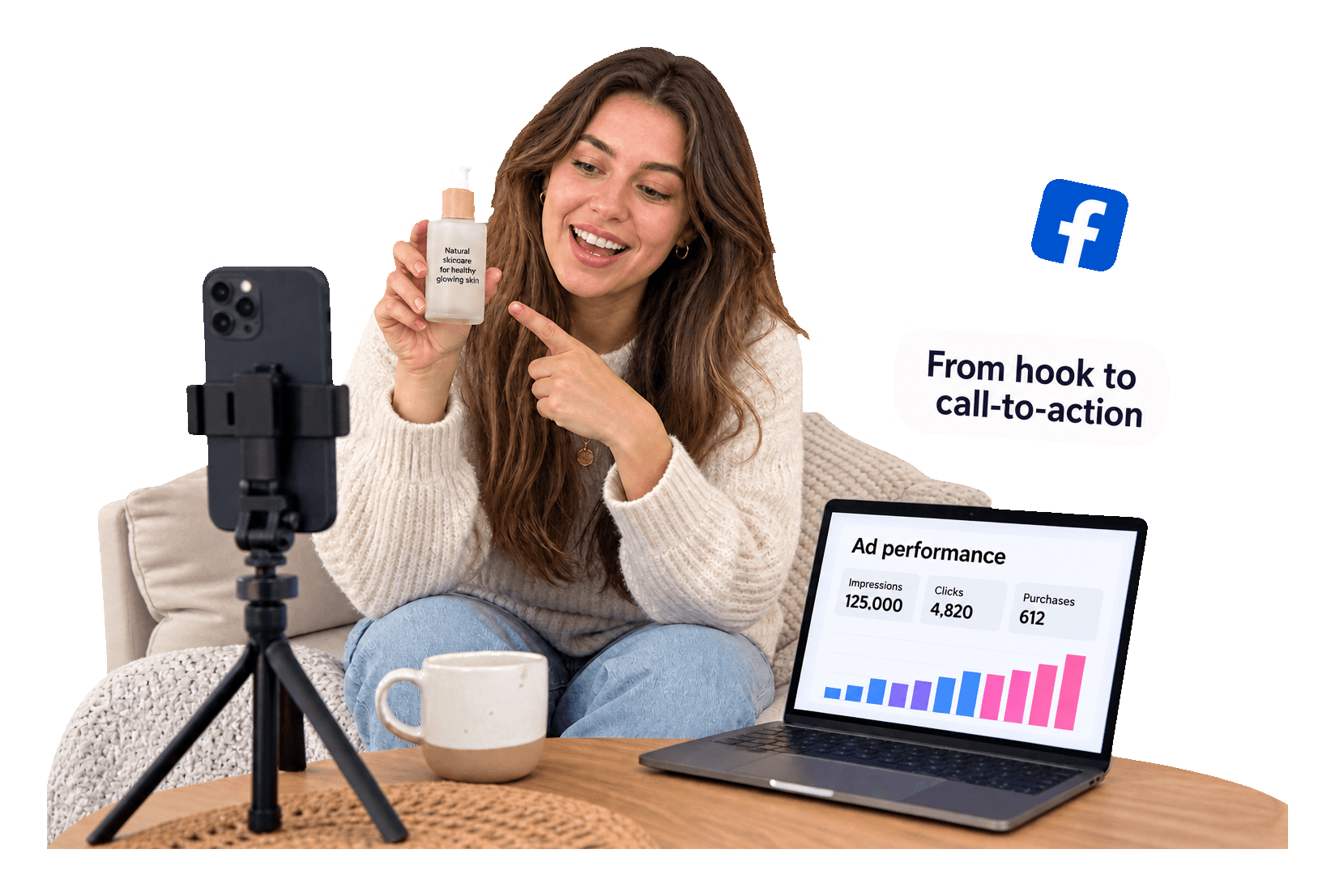
UGC ads have become one of the strongest ad formats on TikTok, Instagram, and Facebook. While a polished ad is often scrolled past immediately, a video from a real user feels like regular content. People watch longer, trust the message more quickly, and are more likely to click through.
However, not every UGC video works as an ad. The difference lies in the structure, the hook, and how you test. In this article, you'll learn how to create UGC ads that convert, which formats work, and how to find the right creators.
TL;DR
- UGC ads are advertisements featuring videos of real people. They are less noticeable as ads and therefore feel more credible in the feed.
- A good UGC ad has a strong hook in the first three seconds, a relatable problem, the product in use, proof, and one clear call-to-action.
- Focus on testing hooks: have the same video made with multiple openings and build on the variant that performs best.
- On UGC.NL, you can choose creators for your ads, order packages with multiple hooks, and agree on usage rights in advance in the chat.
What are UGC ads?
UGC ads are paid advertisements featuring user-generated content: videos that look like they were made by an ordinary customer. Think of someone unboxing your product, giving an honest review, or showing how it works in everyday life.
As a brand, you usually have these videos made by a creator. The creator produces the content on your behalf, and you post the video from your own ad account. You control the budget, the target audience, and the duration of the ad.
This is the big difference from influencer marketing. There, you pay for a post on the influencer's account and for their reach. With UGC ads, you pay for the video itself, and you can test and scale it as much as you want.
You'll see UGC ads everywhere: in the TikTok feed, between Instagram Stories and Reels, and on Facebook. They work for online stores, apps, and service providers, as long as there's a product or experience that someone can credibly showcase.
Why UGC ads often perform better
Social media is made for content from people, not brands. A video that looks like a regular post fits into the feed and is therefore less quickly recognized as an ad. This often results in more watch time, and watch time is exactly what TikTok and Meta's algorithms prioritize.
Additionally, recognition works. If your audience sees someone who looks like them and has the same problem, the message feels personal. A creator saying their skin is calmer after a week is more convincing than a brand promising calmer skin.
Finally, UGC ads are relatively cheap to produce. You don't need a studio, film crew, or actors. This allows you to create and test many more variations, which is in practice the most important reason UGC ads perform so well: you find out what works faster.
The structure of a UGC ad that converts
A good UGC ad feels spontaneous, but rarely is. Almost every ad that sells well has a fixed structure. This gives the creator guidance while leaving enough room for their own words.
Hook: the opening that makes the viewer stop scrolling in the first three seconds
Problem: a relatable situation or frustration of your audience
Solution: your product in use, so the viewer sees how it works
Proof: a concrete result, a detail, or an honest experience
Call-to-action: one clear next step, such as ordering or reading more
Keep the video short. For ads, a length of 15 to 30 seconds usually works best. Add subtitles, as many people watch without sound. Also, make sure the product is clearly visible, preferably in the creator's hands and not just on a table.
Hooks: the first three seconds of your UGC ad
The hook determines whether someone keeps watching. If the opening is weak, almost no one will see the rest of your message, no matter how good it is. That's why it's worth investing more time in your hooks than in the rest of the video.
Type of hook | Example |
|---|---|
Problem | Suffering from oily skin at the end of the day? |
Result | This is my skin after two weeks without makeup. |
Curiosity | No one told me this about serums. |
Honest opinion | I thought this was just another hype. |
Addressing the audience | Do you also work behind a screen all day? |
Combine the spoken hook with movement and text on screen. A creator picking something up, turning around, or walking towards the camera draws more attention than someone sitting still. Display the most important line of the hook as text on screen for those watching without sound.
Five formats for UGC ads
Review
the creator honestly shares their opinion about your product. This is the most used format and works for almost any product because it feels like a recommendation from a friend.
Unboxing
the creator unboxes your product for the first time and reacts. This works well for physical products where packaging or first impressions play a role.
Problem and solution
the video starts with a relatable problem and then shows how your product solves it. Ideal for products that eliminate a clear frustration.
Tutorial
the creator shows step-by-step how to use the product. This helps with new products or those that people have questions about, like an app or a device.
Before and after
the video shows the difference before and after use. Strong in categories like skincare, cleaning, and home, but be honest: exaggerated results can harm your brand and may violate ad regulations.
How to smartly test UGC ads
Don't start with ten different videos, but with one strong video and multiple hooks. Keep the middle section and call-to-action the same and only change the opening. This way, you know exactly which hook makes the difference.
In the first few days, focus on how many people are still watching after three seconds and how often they click through. These numbers say something about your hook. Conversion and cost per purchase say more about the rest of the video, your offer, and your landing page.
Once you have a winner, create new variations based on what works. The same hook with a different creator, or the same creator with a new angle. This prevents your ad from becoming stale after a few weeks and results from dropping.
Also test different creators. A different age, voice, or appearance can make a big difference with the same message, precisely because recognition plays such an important role.
Finding the right creator for your ads
On UGC.NL, you can search for creators among more than 3,000 creators. Filter by language, country, age, gender, niche, and price to find creators who resemble your target audience. Watch the highlight video and pay special attention to the first few seconds: can this creator hold a viewer's attention?
For each creator, you can see reviews, rank, whether assignments were delivered on time, and how quickly the creator responds. If a creator has linked ad results, you can also see how ads with their content perform. This is valuable information if you're specifically looking for ads.
In each package, you can see how many videos and hooks you get, the delivery time, and the number of revisions. For ads, a package with multiple hooks is often the best choice. You can also ask a creator for a custom package in the chat or post a job and receive proposals from creators who fit your campaign.
Rights and agreements for UGC ads
If you want to use a video as an ad, arrange the usage rights in advance. On UGC.NL, UGC.NL transfers the rights to the content to you after the assignment is approved. You agree in advance in the chat with the creator on how long and on which channels you will use the video.
If you want to advertise through the creator's account, such as with Spark Ads on TikTok or partnership ads on Instagram, you need the creator's permission for that account. Discuss this in advance to avoid surprises later.
Also, pay attention to the ad regulations of the platform you're advertising on. Don't promise medical results and don't make claims you can't substantiate. An honest experience is more convincing than an exaggerated promise.
Common mistakes with UGC ads
The first mistake is a video that looks too much like an ad. A creator reading a script word for word doesn't sound credible. Indicate in your briefing what needs to be said, but let the creator do it in their own words.
The second mistake is drawing conclusions too quickly. One video that doesn't perform doesn't mean UGC doesn't work for your brand. Often it's the hook or the creator, and you only discover that by testing.
The third mistake is showing the product too late. Don't wait until the last seconds: show the product early on so that even people who scroll quickly know what the video is about.
Finally, many brands forget the call-to-action. Tell the viewer exactly what to do, and make sure the landing page matches the promise in the video. A strong ad on a weak page yields little.
Find creators for your UGC ads
Filter by language, niche, and price and order your first ad video from €59. Find creators
Frequently asked questions
UGC ads are advertisements with videos that look like they were made by a regular user, such as a review, unboxing, or tutorial. A creator makes the video on behalf of your brand, and then you use it from your own ad account on platforms like TikTok, Instagram, or Facebook, with your own budget and target audience.
Start with three hooks on the same video. This way, you test different openings without having to order multiple complete videos. In the packages on UGC.NL, you can see how many videos and hooks you get per creator. If you need more, ask the creator in the chat for a custom package.
Yes. After the assignment is approved, UGC.NL transfers the rights to the content to you. You agree in advance in the chat with the creator on how long and on which channels you will use the videos. If you want to advertise through the creator's own account, ask for separate permission for that.
Each creator sets their own price for their Basic, Standard, and Premium packages. Packages start at €59 excluding VAT. You see in advance what you get, such as the number of videos, hooks, revisions, and delivery time. There is no subscription, and your account is free.
For ads on TikTok, Instagram, and Facebook, a vertical video of 15 to 30 seconds usually works best. Short enough to hold attention, long enough to show a problem, your product, and a call-to-action. For tutorials or a product page, the video can be longer.